
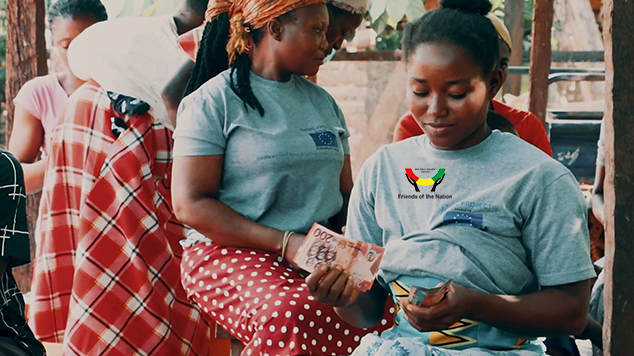
Why VSLAs?
In many of the communities where Friends of the Nation (FoN) works, especially along the four coastal regions of Ghana, people face barriers to formal banking. Banks and microfinance institutions often demand collateral, paperwork, or minimum deposits that smallholder farmers, fishers, women, and youth cannot meet.
The VSLA model is a simple, community-driven system that removes these barriers. It helps people mobilize their own resources, gain access to small but impactful loans, and develop a culture of saving and financial discipline. Friends of the Nation has created VSLA groups in fishing communities and in farming zones across Ghana.
How VSLA Works
FoN follows a structured approach to ensure that VSLA groups are effective, transparent, and sustainable.
1. Community Sensitisation and Mobilisation
FoN facilitators meet with community members to explain the VSLA concept. People are encouraged to form groups voluntarily, usually 15-30 members, often with a balance of women, men, and persons with disabilities.
2. Group Formation and Constitution
Each group agrees on:
- By-laws (rules for contributions, loans, penalties, meeting frequency).
- Leadership roles (chairperson, record-keeper, money counters, box keeper).
- Meeting schedules (often weekly).
- Share value (the fixed amount members contribute each meeting. e.g., GHS 5 or 10).

3. Savings (Shares)
- Each member buys shares at meetings (usually 1- 5 shares per week).
- Savings are recorded in passbooks or ledgers.
- Contributions are pooled into a common fund, stored safely in a locked cash box with multiple key holders for transparency.
4. Loaning Out the Savings
- Members can borrow from the pooled fund, based on group rules.
- Interest rate is usually 5-10% per month, lower than moneylenders and agreed upon by the group.
- Loans are repaid within 1-3 months, depending on group policy.
- Interest earned grows the group’s fund.

5. Social Fund
- In addition to savings, members contribute a small amount (e.g., GHS 1) into a “social fund.”
- This fund is used to support members in emergencies; such as illness, funerals, or school fees, without interest.
6. Record Keeping and Transparency
- Three key holders must be present to open the savings box.
- Transactions are counted publicly during meetings.
- Passbooks and group ledgers track all deposits, loans, and repayments.
7. Financial Literacy and Training
FoN provides training in:
- Household budgeting and savings culture.
- Business skills (pricing, marketing, customer service).
- Record keeping and simple accounting.
- Group governance and conflict resolution.
8. Annual Share-Out
- At the end of a cycle (usually 9-12 months), the total fund (savings + loan interest) is divided among members based on the number of shares they bought.
- Members often use these lump sums for:
- Buying fishing gear or farm inputs.
- Expanding petty trade.
- Paying school or apprenticeship fees.
- Making home improvements.
9. Cycle Renewal
- After share-out, most groups immediately start a new cycle.
- Many increase their share value to allow larger savings and loans.
Impact of FoN’s VSLA Work
Across projects, FoN’s VSLA interventions have:
- Mobilized millions of Ghana cedis in community savings and loans.
- Empowered women and persons with disabilities to actively participate in local economies.
- Strengthened households’ ability to pay for education, healthcare, and daily needs.
- Supported livelihood diversification beyond fishing and farming.
- Created stronger, more cohesive community groups with built-in safety nets.
Example from the ReDIAL Project
- 19 VSLA groups formed
- 581 members (including 121 persons with disabilities)
- Over GHS 1.2 million mobilized in savings and loans
- 80% of members accessed loans for farming, trading, or education
This shows how VSLAs can transform rural and coastal economies when supported with training and inclusion strategies.
Looking Forward
FoN aims to:
- Expand VSLA coverage to more coastal and inland communities.
- Strengthen linkages between VSLAs and formal banks/microfinance institutions.
- Use VSLAs to anchor climate-smart agriculture, sustainable fisheries, and alternative livelihoods programs.
- Ensure inclusion of women, youth, and vulnerable groups as a central pillar.
✅ For FoN, VSLAs are more than financial groups; they are community empowerment platforms that promote self-reliance, resilience, and inclusion.