
Friends of the Nation (FoN) is committed to advancing the International Labour Organization’s C188 Convention (Work in Fishing Convention), which promotes safe, decent, and fair working conditions for fishers. For Ghana’s small-scale fishers, safety and wellbeing at sea are not guaranteed. Daily fishing trips often come with life-threatening risks, compounded by inadequate equipment, harsh weather, and weak monitoring systems. FoN is championing innovation and technology as practical tools to reduce these risks and safeguard lives.
The Challenges Small-Scale Fishers Face
-
Lack of safety gear: Many artisanal fishers go to sea without basic life jackets, making accidents or capsized canoes almost always fatal.
-
No weather forecasting tools: Fishers often set out without knowing sea conditions ahead, exposing themselves to sudden storms and rough seas.
-
Outboard motor breakdowns: Engines frequently break down far offshore, leaving fishers stranded. In some cases, canoes drift for weeks or even months, carried only by wind and currents, until they are rescued, or lost.
-
Canoes destroyed by rough seas: Strong waves and unpredictable waters regularly break canoes, destroying livelihoods and threatening lives.
-
Collisions with bigger vessels: Industrial trawlers and oil service ships sometimes collide with artisanal canoes, causing near misses, injuries, and even deaths.
These problems illustrate why safety at sea must be treated not as a luxury, but as a right.
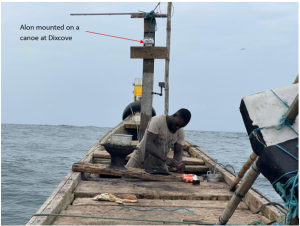
Alon mounted on a canoe at Dixcove in Ghana’s western region
Innovation as a C188 Mechanism
C188 calls for decent work and safety standards for fishers. FoN recognizes that meeting this obligation requires innovative tools and technologies that give small-scale fishers better protection, visibility, and access to information at sea.
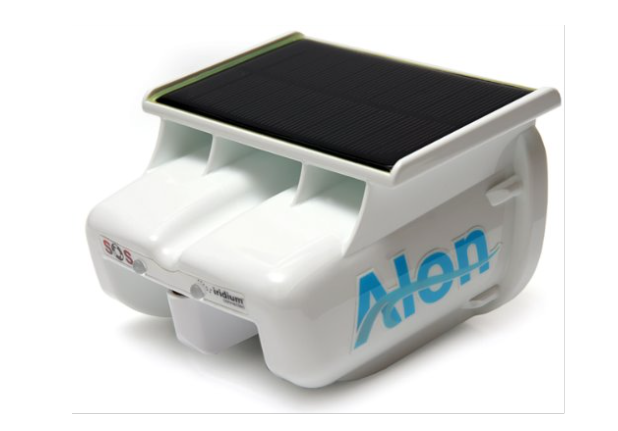
One such innovation is Alon, a digital tool designed to improve safety, reporting, and governance in fisheries.
How Alon Improves Safety and Wellbeing at Sea
Alon comes with features that directly address the safety concerns of small-scale fishers:
-
GPS-enabled tracking: Allows fishers’ locations to be monitored, reducing the risk of being lost at sea when engines fail. Families and authorities can trace their positions for timely rescue.
-
Weather updates: Provides real-time forecasts, helping fishers decide when it is safe to go fishing and when to stay ashore.
-
Emergency alerts (SOS): Fishers can quickly signal distress if canoes are damaged, if accidents occur, or if they are adrift, enabling faster response.

ALON Mounted on a fishing vessel at Dixcove
-
Incident reporting: Fishers can record and report collisions, incursions by industrial vessels, or unsafe practices at sea.
-
Data for governance: Collected information supports better fisheries management, fairer policies, and stronger enforcement of safety regulations.
By introducing technologies like Alon, FoN is helping transform safety at sea from a gamble into a right protected by practical tools, aligning with the principles of C188.
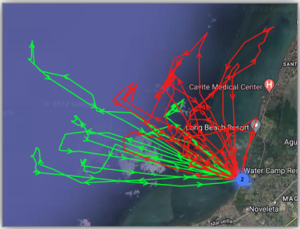
How a canoe with Alon installed on it moved whilst at sea
Why This Matters
For small-scale fishing communities, safety is the foundation of dignity and livelihoods. Every canoe that returns safely means families are sustained, communities are stable, and fisheries governance becomes stronger. By championing technology and innovation, FoN is bridging the gap between policy commitments and real protection at sea, ensuring that small-scale fishers are not left behind in Ghana’s emerging Blue Economy.
Join Us
FoN invites stakeholders, technology partners, and decision-makers to join us in scaling up safety innovations for fishers. Together, we can make Ghana’s seas safer, ensure compliance with C188, and protect the hardworking men and women who provide food security for millions.
📧 Contact us: info@fonghana.org